Abstract
Social Exchange Theory (SET) has been widely recognised as a dominant framework for studying how communities evaluate the impact of tourism in terms of perceived costs and benefits. Understanding community perception is a central concern in tourism research, particularly in the context of sustainable development, because without a supportive host community, it will be very difficult for the tourism industry to grow. This study provides a comprehensive review of how the community perceives the impact of tourism based on the application of SET. Drawing on a wide range of studies from different regions and time periods, this review highlights the key impacts of tourism development on the economic, socio-cultural, and environmental aspects. The review’s findings emphasise that community support for tourism is directly influenced by perceived benefits and costs. A positive perception is formed when the benefits associated with it outweigh the costs, and a negative perception is formed when the costs associated with it outweigh the benefits. Across the literature, the perception of tourism impact is rarely completely positive or negative. Most studies indicate that communities tend to support tourism when perceived benefits outweigh perceived costs, consistent with the principle of Social Exchange Theory. Further, the review shows how the SET evolved from an economic exchange model to a more comprehensive and integrated model that incorporates factors such as sustainable tourism development, community engagement, the importance of governance, trust, power relations, and institutional relations in shaping overall community attitudes toward tourism. This study also highlights significant research gaps, particularly the limited focus on developing regions, where there is a need to incorporate sustainability-oriented variables into the analysis. This study contributes to a deeper understanding of how the community perceives tourism’s impact and highlights directions for future research in tourism policy and planning.
Keywords
Tourism, Social Exchange Theory, Community Perception, Positive Impact of Tourism, Negative Impact of Tourism,
Economic Impact of Tourism, Socio-cultural Impact of Tourism, Environmental Impact of Tourism
1. Introduction
Tourism has emerged as one of the major drivers of economic development worldwide, contributing directly to income generation and employment. The success of the tourism industry is closely tied to the active support of the local population
, without which its sustainability is threatened. Tourism also plays a vital role in regional development by promoting infrastructure growth, enhancing local businesses, and fostering cultural exchanges. However, along with all the benefits, tourism also contributes to socio-economic and environmental costs that directly affect the host community. Therefore, understanding how communities perceive the impact of tourism has become a major concern in tourism research. Particularly with respect to sustainable development
. Local communities are important stakeholders in tourism decision-making
| [4] | Choi, H. S. C., & Sirakaya, E. (2005). Measuring residents’ attitude toward sustainable tourism: Development of sustainable tourism attitude scale. Journal of Travel Research, 43(4), 380–394. https://doi.org/10.1177/0047287505274651 |
[4]
.
According to the World Travel & Tourism Council (WTTC), tourism is one of the largest and fastest-growing economic sectors in the world, contributing approximately 10% of the global GDP and supporting approximately one in ten jobs worldwide, highlighting its critical role in economic development and livelihood generation. It measures the contribution of tourism through three key components: direct, indirect, and induced impacts of tourism.
The long-term success of tourism development largely depends on the acceptance and support of the community
. Community perceptions are often shaped by social interactions and individuals’ evaluations of the costs and benefits associated with them. In this context, Social Exchange Theory (SET) has been widely used as a dominant framework and model for understanding community perceptions of tourism development. Social Exchange Theory is a sociological framework that highlights social behaviour as a social process of evaluating costs and benefits, where an individual seeks to minimise costs and maximise benefits. SET explains that individuals evaluate and conduct assessments based on their perceived benefits and costs. When applied to tourism, this theory suggests that communities are more likely to support and favour tourism development if they perceive that its benefits, such as economic opportunities, infrastructure development, and enhanced quality of life, outweigh its associated costs, including environmental degradation, cultural commodification, and social inequality
| [6] | Ap, J. (1992). Residents’ perceptions of tourism impacts. Annals of Tourism Research, 19(4), 665–690.
https://doi.org/10.1016/0160-7383(92)90060-3 |
| [7] | Perdue, R. R., Long, P. T., & Allen, L. (1990). Resident support for tourism development. Annals of Tourism Research, 17(4), 586–599. https://doi.org/10.1016/0160-7383(90)90029-Q |
[6, 7]
. Therefore, the balance between these perceived benefits and costs plays a crucial role in shaping the community’s perception of tourism.
2. Background of the Study and Evolution of SET
SET was initially developed by
, and since its origin in sociology and social psychology, it has evolved significantly and has become one of the most widely used frameworks for understanding human interaction and decision-making. This theory emphasises that social behaviour can be understood as an exchange process in which one seeks to maximise benefits and minimise costs. It emphasises basic behavioural theory, suggesting that people repeat actions that are rewarded and avoid those that are punished
. Based on this foundation theory, Peter M. Blau in 1964 expanded the theory by adding a more complex sociological perspective. He further highlighted that social exchanges go beyond simple economic transactions and incorporate intangible elements such as trust, power, and social obligations. He emphasised that social relationships are formed and maintained through reciprocal exchanges, which may not always be immediately balanced but are sustained over time through mutual expectations
| [9] | Blau, P. M. (1964). Exchange and Power in Social Life. Wiley. No DOI available. |
[9]
.
Further,
contributed to the theoretical enhancement of SET by emphasising the role of power and dependency in the framework. He emphasised social exchange as a network of relationships in which power dynamics play a central role, thereby linking micro-level interactions to broader social structures. This contribution marked a shift from an individual-level perspective to a more structural understanding of social relationships.
Over time, SET evolved from a predominantly behavioural and economic model to a multidimensional framework incorporating psychological and relational factors. Concepts such as reciprocity, trust, and fairness have become central to explaining long-term social interactions. This theoretical advancement and evolution allowed SET to be applied across diverse disciplines, including marketing, sociology, psychology, and organisational studies.
The application of SET in tourism research gained prominence with the work of
, who introduced SET to explain residents’ perceptions of tourism impacts. He proposed that local communities evaluate tourism development through a cost–benefit analysis and assessment, explaining that support is received only when the perceived benefits outweigh the associated costs. This contribution marked a significant milestone in tourism studies, as it provided a theoretical basis for understanding community attitudes toward tourism.
Subsequent research has broadened the application of SET in tourism by incorporating variables beyond economic benefits
. Studies conducted by
and
| [12] | Andereck, K. L., Valentine, K. M., Knopf, R. C., and Vogt, C. A. (2005). Residents’ perceptions of community tourism impacts. Annals of Tourism Research, 32(4), 1056–1076.
https://doi.org/10.1016/j.annals.2005.03.001 |
[12]
incorporated socio-cultural and environmental factors. Building on this, later research by
introduced elements such as perceived power and trust in the government. More recent contributions by
| [14] | Rasoolimanesh, S. M., Jaafar, M., Kock, N., & Ahmad, A. G. (2015). A revised framework of social exchange theory. Tourism Management Perspectives, 16, 335-345.
https://doi.org/10.1016/j.tmp.2015.10.001 |
[14]
have further extended and advanced the SET framework by integrating sustainability, community attachment, and environmental concerns.
Thus, the evolution of the SET in tourism demonstrates a transition from a basic cost–benefit approach to a more comprehensive framework that accounts for economic, social, environmental, and institutional dimensions. Although the theory is being criticised regarding its assumption of rationality. Yet, it continues to serve as a robust and adaptable theory for studying and understanding community perceptions, particularly in the context of tourism development.
Recent studies by
highlighted emerging issues such as over-tourism and technological influences on residents’ perceptions. Furthermore,
| [16] | Shi, J., Rasoolimanesh, S. M., & Woosnam, K. M. (2024). A systematic review of residents’ perceptions towards tourism development in ethnic tourism contexts. Journal of Tourism and Cultural Change, 22(4), 382–406.
https://doi.org/10.1080/14766825.2024.2401838 |
[16]
introduced additional dimensions, including sociopolitical factors, alongside economic, socio-cultural, and environmental aspects. emphasised the importance of governance, trust, power relations, and institutional relations in shaping overall community attitudes toward tourism. More recent studies have highlighted the role of community attachment and residents’ perceptions in shaping support for sustainable tourism development. These advancements demonstrate that SET is increasingly being applied as a holistic and dynamic framework, incorporating sustainability, governance, trust and community-based perspectives in understanding residents’ attitudes toward tourism.
3. Significance of the Study
The significance of this study lies in its comprehensive examination of community perceptions of tourism development through the lens of SET, a dominant and evolving framework in tourism research. By synthesising findings across diverse geographical contexts and temporal spans, this study highlights how community support for tourism is fundamentally shaped by the balance between perceived benefits and costs across economic, socio-cultural, and environmental dimensions. This research advances understanding by tracing the theoretical evolution of the SET from a primarily economic exchange model to a multidimensional framework that incorporates sustainability, governance, trust, and community participation. Moreover, this study identifies critical gaps in the existing literature, particularly the scarcity of research focused on rural and developing regions, longitudinal analyses of perception changes, and the integration of institutional and policy factors. Addressing these gaps, this study provides valuable insights for policymakers, planners, and scholars aiming to foster sustainable tourism development that is inclusive, equitable, and responsive to community needs. Ultimately, this study contributes to the refinement of SET-based models by advocating for a more holistic and context-sensitive approach, thereby enhancing the theoretical and practical understanding of how tourism impacts are perceived and managed at the community level.
4. Conceptual Framework
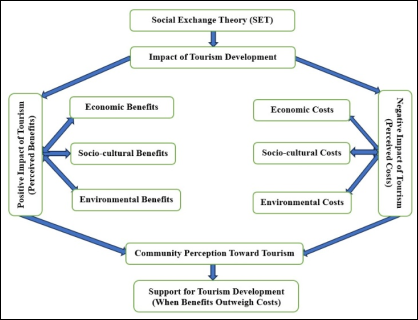
The conceptual framework of this study is grounded in SET, which serves as the foundational theoretical lens for understanding how communities evaluate tourism development based on their perceived costs and benefits. According to SET, individuals and communities form their perceptions by assessing the balance between the positive and negative impacts of tourism across three primary dimensions: economic, socio-cultural, and environmental. These perceived benefits and costs influence the overall community attitude and support for tourism development.
Figure 1. Conceptual Framework of SET designed by authors.
Within this framework, economic benefits may include income generation, employment opportunities, infrastructure development, and business expansion, whereas economic costs may involve income inequality, inflation, and economic dependency. Socio-cultural benefits encompass cultural exchange, community pride, cultural preservation, and enhanced social interactions, contrasted by potential costs such as cultural commodification, social conflict, and disruption of local lifestyles. Environmental benefits are characterised by increased awareness, conservation efforts, and improved environmental management. Environmental costs include pollution, overcrowding, resource depletion, and environmental degradation.
Figure 1 shows that the framework posits that community support for tourism development is more likely when perceived benefits outweigh perceived costs across these dimensions. Furthermore, the model acknowledges that factors such as community participation, governance, trust, power relations, and institutional dynamics mediate these perceptions and influence the exchange processes. This multidimensional and integrative approach reflects the evolution of SET from a primarily economic exchange model to a comprehensive framework that incorporates sustainability and social dynamics in assessing community perception.
Thus, the framework guides a systematic examination of how residents evaluate tourism impacts, emphasising the importance of balancing benefits and costs while considering broader social and institutional contexts to foster sustainable and inclusive tourism development.
5. Research Objectives
The objectives of this study are to examine the evolution of SET in tourism from its origins as an economic exchange model to its current form as a sustainability-oriented framework. This study aims to analyse how residents evaluate tourism development by focusing on the perceived economic, sociocultural, and environmental benefits and costs within the SET framework. Additionally, it seeks to identify the key factors that contribute to the positive and negative impacts of tourism on communities. Another objective was to explore how these perceived benefits and costs influence overall community perceptions and support for tourism development. Finally, this study highlights existing research gaps and proposes directions for future studies that integrate sustainability, governance, community participation, and institutional dynamics in tourism policy and planning.
6. Research Methodology
This study followed a systematic literature review approach to understand the community's perception of tourism development. Relevant research was retrieved from reputed journals, and data were extracted and analysed using a thematic approach, including tabular synthesis, to identify key patterns and different tourism impacts, such as economic, socio-cultural, and environmental factors. Longitudinal trend analysis was also used to examine the evolution of SET research over time.
7. Literature Review
The literature review systematically synthesises existing research on the multidimensional impact of tourism. An integrated assessment of the impact of tourism on community perception is presented in the table, drawing on the SET model to examine perceived benefits and costs, identify key factors driving positive and negative impacts, and analyse their influence on residents’ perception of tourism development. A significant number of studies highlight that communities evaluate tourism impacts across three primary dimensions: Economic, Socio-Cultural, and Environmental.
7.1. Economic Impact of Tourism
Economic factors are considered among the most important aspects of shaping a community's perception. It can create both positive and negative perceptions.
Table 1. Studies on Social Exchange Theory: Exploring Economic Impacts of Tourism and Practical Applications.
Author(s) & Year | Journal | Use of SET in Study | Positive Economic Impact | Negative Economic Impact | Do Benefits Outweigh Costs? |
Ap (1992) | Annals of Tourism Research | Residents perceived tourism based on benefits vs costs | Income growth, Employment generation | Inflation, Inequal income distribution | Benefits outweigh costs |
Jurowski et al. (1997) | Journal of Travel Research | Residents attitude is influence by economic dependency | Better living standard | Inequal distribution of income, Dependency on single sector | Benefits outweigh costs |
Gursoy et al. (2002) | Annals of Tourism Research | Linkage between perceived impact and support | Infrastructure development, Investment opportunities | Higher cost of living | Benefits outweigh costs |
Ko & Stewart (2002) | Tourism Management | Perceived exchange benefits lead to satisfaction | Employment generation, Better services | Economic leakage | Benefits outweigh costs |
Andriotis & Vaughan (2003) | Journal of Travel Research | Attitude of residents depends on level of benefits received | Employment generation and entrepreneurship development. | Disparity in income | Benefits outweigh costs |
Andereck et al. (2005) | Annals of Tourism Research | Study of multi-dimensional impact of tourism using SET framework | Income for local, Expansion of business | Higher cost of living, Increase of land value | Mixed/ Conditional |
Nicholas et al. (2009) | Tourism Analysis | SET shows support for conservation via economic benefits | Growth of local economy, Revenue generation | Inequal distribution of income | Benefits outweigh costs |
Nunkoo & Ramkissoon (2012) | Annals of Tourism Research | Power and Trust influence perception | Economic development | Inequal distribution of income, Dominance by Elite | Costs outweigh benefits for some groups |
Rasoolimanesh et al. (2015) | Tourism Management Perspectives | Perceived benefits enhance by community participation, influence support for tourism | Increase in income, More business opportunity | Unequal distribution of benefits, Overdependence on tourism, over utilization of local resources | Benefits outweigh costs |
Caro-Carretero & Monroy-Rodríguez (2025) | Cogent Social Sciences | SET used to see residents’ perception for sustainable tourism planning | Contribution to local economic development | Concerns regarding over-tourism and costs of future | Mixed/ Conditional support |
Table 1 presents a chronological review of the economic impact of tourism studies that use Social Exchange Theory to understand community perceptions of tourism development. The findings reveal several important trends and patterns. Social Exchange Theory has dominated tourism studies since 1992. Social Exchange Theory is used as a theoretical foundation for studying community perceptions of tourism development based on perceived benefits and costs. Most studies support the Social Exchange Theory, which explains that the community tends to support tourism when the perceived benefits outweigh the costs. Earlier studies by
and
stressed economic impact perspectives, which were later extended to include participation, power, trust, sustainability, and community involvement. The table also shows the consistency in the findings of the positive economic impacts of tourism, which include employment generation, income growth, infrastructure development, improvement in living standards, business expansion, investment opportunities, and economic development. The most repeated positive economic impact appearing in almost all studies is employment generation and income opportunities. This highlights that economic benefits, such as employment generation, increased income, and business opportunities, are the primary reasons for communities to support tourism development. While concerns regarding the unequal distribution of income are one of the most repeated negative impacts which appears in the study of
| [12] | Andereck, K. L., Valentine, K. M., Knopf, R. C., and Vogt, C. A. (2005). Residents’ perceptions of community tourism impacts. Annals of Tourism Research, 32(4), 1056–1076.
https://doi.org/10.1016/j.annals.2005.03.001 |
| [14] | Rasoolimanesh, S. M., Jaafar, M., Kock, N., & Ahmad, A. G. (2015). A revised framework of social exchange theory. Tourism Management Perspectives, 16, 335-345.
https://doi.org/10.1016/j.tmp.2015.10.001 |
[12, 14]
and
| [17] | Jurowski, C., Uysal, M., & Williams, D. R. (1997). A theoretical analysis of host community resident reactions to tourism. Journal of Travel Research, 36(2), 3–11.
https://doi.org/10.1177/004728759703600202 |
| [18] | Nicholas, L. N., Thapa, B., & Ko, Y. J. (2009). Residents’ perspectives of a World Heritage Site: The Pitons Management Area, St. Lucia. Tourism Analysis, 14(2), 251–263.
https://doi.org/10.1016/j.annals.2009.03.005 |
| [19] | Nunkoo, R & Ramkissoon, H. (2012). Power, trust, social exchange and community support for tourism: A structural equation modelling approach. Annals of Tourism Research, 39(2), 997–1023. https://doi.org/10.1016/j.annals.2011.11.017 |
[17-19]
. The repeated appearance of this issue suggests that while tourism may generate wealth and income for the region, the benefits are often enjoyed by certain groups of people who are business owners, elites, or politically powerful individuals. The study also shows that perceptions are influenced not only by benefits but also by participation, fairness, accessibility, and equal opportunity. The above table also highlights the shift in tourism research, where early SET research focused on economic growth, employment, infrastructure, and support for tourism, but recent SET studies have expanded to governance, trust, community participation, sustainability, over-tourism, and resource overuse, which indicates that tourism development is no longer assessed through economic gains but also through long-term sustainability. Only a few studies have shown that the costs outweigh the benefits for some groups. This highlights that communities are generally willing to support tourism if they receive benefits, are involved in decision-making, negative impacts are controlled, and tourism development is sustainable.
7.2. Socio-cultural Impact of Tourism
Table 2 highlights the major impact of tourism on socio-economic effects.
Table 2. Studies on Social Exchange Theory: Exploring Socio-cultural Impacts of Tourism and Practical Applications.
Author(s) & Year | Journal | Use of SET in Study | Positive Socio-Cultural Impact | Negative Socio-Cultural Impact | Do Benefits Outweigh Costs? |
Ap (1992) | Annals of Tourism Research | Residents value tourism based on perceived cost vs benefits | Exchange of culture, Community pride improves | Crowding, Conflicts in society, Disruption of cultural | Depends on benefits received. |
Jurowski, Uysal & Williams (1997) | Journal of Travel Research | Residents attitude is explained based on SET via benefits vs cost | Cultural awareness increased, Better social interaction | Commodification of culture, loss of local identity | Benefits outweigh over cost |
Gursoy, Jurowski & Uysal (2002) | Annals of Tourism Research | SET model is used to predict support for tourism | Cultural preservation, Community identity strengthen | Local lifestyle disruption, social tension | Mixed result |
Nunkoo and Ramkissoon (2012) | Annals of Tourism Research | Trust and power is integrated with SET to explain perceptions | Better participation, Improved social life | Mistrust, Social conflict, Inequality | Context-dependent |
Rasoolimanesh et al. (2015) | Tourism Management Perspectives | Linked community factors with SET to study perception | Cultural identity strength with community attachment | With more participation negative perception reduce | When involvement is high better perception |
Rasoolimanesh et al. (2017) | Journal of Sustainable Tourism | SET applied to study community perception | Community pride, Conservation of cultural heritage | Not equal distribution of benefits, Cultural conflicts | Yes, When community benefit is visible |
Lwoga (2018) | Bulletin of Geography: Socio-economic Series | ET is applied to study how perception influence support | Awareness of cultural heritage, Cultural education | Commodification of culture, Social change | Mixed |
Table 2 shows the socio-cultural impact of tourism using the Social Exchange Theory to explain the community’s perception of tourism development. The study shows that the community evaluates tourism not only by economic aspects but also by socio-cultural aspects through changes in cultural, social relationships, identity, and community life. The central assumption across these studies is that communities are likely to support tourism when the socio-cultural benefits outweigh the socio-cultural costs. This table reveals several recurring positive socio-cultural impacts of tourism, with the most common being cultural exchange, followed by community pride, cultural preservation, improved recreation, awareness of cultural heritage, community attachment and participation in local development. Among these, community pride, cultural exchange, and cultural preservation appear repeatedly across studies.
found that tourism encourages cultural exchange and improves community pride.
highlighted that tourism strengthens community identity and cultural preservation. These findings suggest that tourism can strengthen local identity and help preserve traditional culture when properly managed and controlled. Although tourism generates socio-cultural benefits, it also reports several socio-cultural costs, including social conflicts, tension, cultural commodification, loss of local identity, lifestyle disruption, mistrust, and social value disruption. One of the most common and repeated concerns is cultural commodification. This highlights that the commodification of local traditions and culture sometimes reduces authenticity. The table also reflects an important shift from cultural exchange and social disruption to balancing tourism with cultural sustainability and community well-being.
7.3. Environmental Impact of Tourism
Table 3 highlights the environmental impact of tourism.
Table 3. Studies on Social Exchange Theory: Exploring Environmental Impacts of Tourism and Practical Applications.
Author(s) & Year | Journal | Use of SET in Study | Positive Environmental Impact | Negative Environment Impact | Do Benefits Outweigh Costs? |
Ap (1992) | Annals of Tourism Research | SET model was used to assess residents based on cost-benefit exchange | Increase in environmental awareness | Pollution, Degradation of environment | Mixed/Mostly depends on perception |
Jurowski et al. (1997) | Journal of Travel Research | SET Model links perceived impact with support | Awareness about conservation | Environmental stress, Crowding, | Mixed |
Gursoy et al. (2002) | Annals of Tourism Research | SET used to explain support through perceived benefits | Infrastructure development | Resource depletion | Positive |
Ko & Stewart (2002) | Tourism Management | Assess residents attitude using SET | Improved facilities | Pollution and environmental stress | Mixed |
Andereck et al. (2005) | Journal of Travel Research | SET framework to study attitudes base on perceived impact | Awareness about protection of environment | Traffic, Waste problem | Mixed |
Nunkoo & Ramkissoon (2011) | Annals of Tourism Research | SET extended with trust and governance | Environmental planning | Concern of environment remains | Positive |
Rasoolimanesh et al. (2015) | Tourism Management Perspectives | SET model with community participation | Awareness and sustainable practices | Over-crowding, Pollution | Positive |
Kattiyapornpong et al. (2021) | Int. Journal of Innovation & Sustainable Development | SET framework applied to sustainability perceptions | Better environmental management | Environmental pressure | Mixed |
Table 4. Overall impacts of tourism.
Authors and Year | Key findings | Perceived impact |
Ap (1992); Jurowski et al. (1997); Gursoy et al. (2002); Ko & Stewart (2002); Andereck et al. (2005); Andriotis & Vaughan (2003); Nicholas et al. (2009); Nunkoo and Ramkisson (2011); Rasoolimanesh et al. (2015); Lwoga (2018); Kattiyapornpong et al. (2021). | Residents generally show positive perceptions when economic gains (income, employment), socio-cultural benefits (cultural exchange, community pride, and participation), and environmental conservation (awareness conservation and infrastructure) are visible. Support improves when gains are tangible and direct. | Positive |
Andereck et al. (2005); Gursoy et al. (2002); Ko & Stewart (2002); Nicholas et al. (2009); Kattiyapornpong et al. (2021); Caro-Carretero & Monroy-Rodríguez (2025); Lwoga (2018); Perdue et al. (1990); Pizam (1978); Gursoy & Rutherford (2004); Seyedali Rasoolimanesh et al. (2017); Zhuang et al. (2019); Sharpley (2014); Sharpley & Telfer (2014); Nunkoo (2016); Rasoolimanesh & Seyfi (2020) | The study shows a range of perceptions toward tourism rather than uniformity of perceptions. Some aspects of tourism are perceived negatively because of the unequal distribution of gains, dominance by the elite, and social inequality, despite its overall economic benefits. Governance-related factors such as trust and power play crucial roles in shaping positive perceptions. Positive perceptions also appear when residents are allowed to participate in decision-making and benefits are fairly and equally distributed. | Mixed/ Conditional |
Ko & Stewart (2002); Sánchez -Teba et al. (2019); Kattiyapornpong et al. (2021). | Negative tourism perceptions coexist with positive place attachment and community loyalty | It is not entirely negative but coexists with positive place-based sentiments. |
Cavus & Tanrisevdi (2003) | 63 per cent of the residents perceived tourism negatively because it increases the variety of problems at the destination. | Majority negative. |
All the studies in
Table 3 explain that the community assesses tourism development based on environmental rewards and consequences.
| [17] | Jurowski, C., Uysal, M., & Williams, D. R. (1997). A theoretical analysis of host community resident reactions to tourism. Journal of Travel Research, 36(2), 3–11.
https://doi.org/10.1177/004728759703600202 |
[17]
linked perceived environmental impact with support for tourism.
| [20] | Kattiyapornpong, U., Chuntamara, C., & Ditta-Apichai, M. (2021). Social exchange theory in sustainable tourism: A case study from Thailand. International Journal of Innovation and Sustainable Development, 15(3), 248–260.
https://doi.org/10.1504/IJISD.2021.115958 |
[20]
extended SET to sustainability perceptions. Compared to the economic impacts, the positive environmental impacts are relatively less and indirect in nature. The most frequently observed positive impact was increased awareness of environmental conservation. On the other hand, the negative impact of tourism and environmental costs is more constantly emphasised than the environmental benefits, including pollution, overcrowding, traffic congestion, waste generation, resource depletion, and environmental stress. Among these, pollution, overcrowding, and waste generation were the most frequently mentioned, suggesting that environmental concerns are the most sensitive aspects of tourism development. Unlike economic and socio-cultural perceptions, where benefits outweigh costs, environmental perceptions are more uncertain and cautious. Several studies have reported mixed perceptions. This suggests that the community tends to support tourism when environmental degradation remains under control. Thus, sustainable environmental management of tourism’s impact is essential for long-term community support.
8. Review Findings
Studies applying Social Exchange Theory (SET) across diverse geographical contexts indicate that communities’ perceptions of tourism impacts range from positive to negative and are often mixed. Early work by
states that communities evaluate tourism impact based on a cost–benefit analysis, with positive perceptions developed when the perceived benefits outweigh the costs. Empirical studies, for example,
| [5] | Gursoy, D., Jurowski, C., & Uysal, M. (2002). Resident attitudes: A structural modelling approach. Annals of Tourism Research, 29(1), 79–105.
https://doi.org/10.1016/S0160-7383(01)00028-7 |
| [12] | Andereck, K. L., Valentine, K. M., Knopf, R. C., and Vogt, C. A. (2005). Residents’ perceptions of community tourism impacts. Annals of Tourism Research, 32(4), 1056–1076.
https://doi.org/10.1016/j.annals.2005.03.001 |
| [17] | Jurowski, C., Uysal, M., & Williams, D. R. (1997). A theoretical analysis of host community resident reactions to tourism. Journal of Travel Research, 36(2), 3–11.
https://doi.org/10.1177/004728759703600202 |
| [21] | Ko, D. W., & Stewart, W. P. (2002). A structural equation model of residents’ attitudes for tourism development. Tourism Management, 23(5), 521–530.
https://doi.org/10.1016/S0261-5177(02)00006-7 |
[5, 12, 17, 21]
highlight that improved infrastructure, economic development, employment opportunities, and enhanced living standards contribute to favourable perceptions. Similar findings have been reported in European and island contexts, where economic benefits and conservation efforts directly influence community participation
| [22] | Andriotis, K., & Vaughan, R. D. (2003). Urban residents’ attitudes toward tourism development. Journal of Travel Research, 42(2), 172–185. https://doi.org/10.1177/0047287503257488 |
| [18] | Nicholas, L. N., Thapa, B., & Ko, Y. J. (2009). Residents’ perspectives of a World Heritage Site: The Pitons Management Area, St. Lucia. Tourism Analysis, 14(2), 251–263.
https://doi.org/10.1016/j.annals.2009.03.005 |
[22, 18]
. However, community perceptions are frequently conditional. Research highlights that economic benefits may be present, but concerns such as environmental degradation, social disruption, cultural degradation, and economic dependency also accompany them
| [5] | Gursoy, D., Jurowski, C., & Uysal, M. (2002). Resident attitudes: A structural modelling approach. Annals of Tourism Research, 29(1), 79–105.
https://doi.org/10.1016/S0160-7383(01)00028-7 |
| [7] | Perdue, R. R., Long, P. T., & Allen, L. (1990). Resident support for tourism development. Annals of Tourism Research, 17(4), 586–599. https://doi.org/10.1016/0160-7383(90)90029-Q |
| [12] | Andereck, K. L., Valentine, K. M., Knopf, R. C., and Vogt, C. A. (2005). Residents’ perceptions of community tourism impacts. Annals of Tourism Research, 32(4), 1056–1076.
https://doi.org/10.1016/j.annals.2005.03.001 |
[5, 7, 12]
. Evidence from developing regions also shows that tourism can promote sustainability and cultural awareness simultaneously while creating environmental pressure and cultural commodification
| [20] | Kattiyapornpong, U., Chuntamara, C., & Ditta-Apichai, M. (2021). Social exchange theory in sustainable tourism: A case study from Thailand. International Journal of Innovation and Sustainable Development, 15(3), 248–260.
https://doi.org/10.1504/IJISD.2021.115958 |
| [23] | Lwoga, N. B. (2018). Heritage proximity, attitudes to tourism impacts and residents’ support for heritage tourism in Kaole Site, Tanzania. Bulletin of Geography. Socio-economic Series, 42(42), 163–181. https://doi.org/10.2478/bog-2018-0037 |
[20, 23]
. Perceptions are also shaped by factors such as community participation, governance and trust.
| [13] | Nunkoo, R., & Ramkissoon, H. (2011). Developing a community support model for tourism. Annals of Tourism Research, 38(3), 964–988. https://doi.org/10.1016/j.annals.2011.01.017 |
| [19] | Nunkoo, R & Ramkissoon, H. (2012). Power, trust, social exchange and community support for tourism: A structural equation modelling approach. Annals of Tourism Research, 39(2), 997–1023. https://doi.org/10.1016/j.annals.2011.11.017 |
[13, 19]
highlighted the role of power distribution and institutional trust, while
| [14] | Rasoolimanesh, S. M., Jaafar, M., Kock, N., & Ahmad, A. G. (2015). A revised framework of social exchange theory. Tourism Management Perspectives, 16, 335-345.
https://doi.org/10.1016/j.tmp.2015.10.001 |
| [24] | Rasoolimanesh, S. M., Ringle, C. M., Jaafar, M., & Ramayah, T. (2017). Urban vs. rural destinations: Residents’ perceptions of community participation and support for tourism development. Tourism Management. 60, 147-158.
https://doi.org/10.1016/j.tourman.2016.11.019 |
[14, 24]
highlighted the importance of community engagement and perceived personal benefits. Unequal distribution of benefits may also lead to negative perceptions among certain groups, despite overall economic benefits. Furthermore, the influence of perceived benefits and costs on community perception of tourism supports the core proposition of SET, where communities are likely to support tourism development when perceived benefits outweigh perceived costs. Many studies
| [5] | Gursoy, D., Jurowski, C., & Uysal, M. (2002). Resident attitudes: A structural modelling approach. Annals of Tourism Research, 29(1), 79–105.
https://doi.org/10.1016/S0160-7383(01)00028-7 |
| [6] | Ap, J. (1992). Residents’ perceptions of tourism impacts. Annals of Tourism Research, 19(4), 665–690.
https://doi.org/10.1016/0160-7383(92)90060-3 |
| [14] | Rasoolimanesh, S. M., Jaafar, M., Kock, N., & Ahmad, A. G. (2015). A revised framework of social exchange theory. Tourism Management Perspectives, 16, 335-345.
https://doi.org/10.1016/j.tmp.2015.10.001 |
| [18] | Nicholas, L. N., Thapa, B., & Ko, Y. J. (2009). Residents’ perspectives of a World Heritage Site: The Pitons Management Area, St. Lucia. Tourism Analysis, 14(2), 251–263.
https://doi.org/10.1016/j.annals.2009.03.005 |
[5, 6, 14, 18]
have indicated that economic benefits often play a key role in shaping positive perceptions. However, this relationship is not always linear. However, in contexts where benefits are not evenly distributed or where trust in governance is low, certain groups may have a negative perception despite overall economic benefits. This further shows that perception is developed not only by the magnitude of benefits but also by community engagement, fairness, good governance, transparency, trust, a sustainable approach, and inclusiveness.
Therefore, the reviewed studies show that Social Exchange Theory is a dominant framework used to understand community perceptions of tourism. Economic benefits, such as employment generation, business opportunities, and income growth, encourage community participation. However, concerns regarding the unequal distribution of benefits, dependency on a single tourism sector, and sustainability issues influence the reduction in community support.
The review studies also highlight that the Social Exchange Theory effectively explains the community's socio-cultural perception of tourism. Positive impacts, including cultural preservation, cultural exchange, community pride, and improved social interaction, mostly encourage communities’ support for tourism. However, some socio-cultural costs, such as cultural commodification, social conflicts, and overcrowding, reduce support for tourism development.
The reviewed studies further indicate that Social Exchange Theory effectively assesses communities’ environmental perceptions. Environmental benefits, such as environmental awareness, conservation practices, and proper management, encourage tourism support. However, environmental costs, such as pollution, overcrowding, and environmental degradation, often create mixed perceptions.
Therefore, recent studies have highlighted the increasing importance of community participation, trust, sustainable tourism planning, and important determinants in shaping community perceptions and ensuring sustainable tourism development.
In the literature, tourism perception based on its impact is rarely completely positive or completely negative. Most findings show that communities support tourism when perceived benefits outweigh perceived costs, supporting the Social Exchange Theory.
9. Discussion
The reviewed literature clearly demonstrates the revolution in the application of Social Exchange Theory (SET) in tourism studies. Primarily, works such as
used SET as an economic exchange model, in which the community evaluates tourism in terms of tangible benefits, such as employment opportunities and income generation, against costs, such as inflation and income inequality. Over time, this perspective has broadened into a multidimensional, sustainability-oriented framework, as seen in the work of
| [13] | Nunkoo, R., & Ramkissoon, H. (2011). Developing a community support model for tourism. Annals of Tourism Research, 38(3), 964–988. https://doi.org/10.1016/j.annals.2011.01.017 |
| [19] | Nunkoo, R & Ramkissoon, H. (2012). Power, trust, social exchange and community support for tourism: A structural equation modelling approach. Annals of Tourism Research, 39(2), 997–1023. https://doi.org/10.1016/j.annals.2011.11.017 |
[13, 19]
and
| [14] | Rasoolimanesh, S. M., Jaafar, M., Kock, N., & Ahmad, A. G. (2015). A revised framework of social exchange theory. Tourism Management Perspectives, 16, 335-345.
https://doi.org/10.1016/j.tmp.2015.10.001 |
| [24] | Rasoolimanesh, S. M., Ringle, C. M., Jaafar, M., & Ramayah, T. (2017). Urban vs. rural destinations: Residents’ perceptions of community participation and support for tourism development. Tourism Management. 60, 147-158.
https://doi.org/10.1016/j.tourman.2016.11.019 |
[14, 24]
. Later, these studies broadened and integrated other elements, such as community participation, sustainability, trust, and governance, highlighting that perceptions of the community are formed not only by economic factors but also by environmental and socio-cultural factors. This shift indicates that the SET model has transformed from a single cost–benefit framework to a multidimensional and holistic model emphasising sustainable tourism development and balanced growth. The literature consistently shows that perceptions are formed based on a balance of perceived benefits and costs across economic, socio-cultural, and environmental aspects. In terms of economics, communities acknowledge benefits such as employment opportunities, income generation, business opportunities, development of the local economy, and overall growth of GDP, while also recognising issues such as inflation, leakage, and unequal income distribution. In terms of socio-cultural aspects, tourism contributes to cultural exchange, community pride, cultural awareness, culture and heritage preservation, and improved social interaction, but may also lead to the commodification of culture, social conflict, and loss of identity. Environmentally, tourism increases environmental awareness, improves facilities, and enhances awareness, conservation efforts, and infrastructure development, but simultaneously leads to pollution, environmental stress, overcrowding, traffic, and resource depletion. Thus, residents’ perceptions are formed through an evaluation of tourism impacts, which is inherently multidimensional and context-dependent rather than based on a single factor.
Furthermore, the literature identifies several key elements that contribute to the positive and negative impacts of tourism. Studies show that positive perceptions and impacts are largely driven by direct and visible economic benefits, equal distribution of income, community participation, cultural preservation, cultural exchange, environmental awareness, trust, and effective governance. On the other hand, negative impacts arise from environmental degradation, overcrowding, unequal distribution of benefits, seasonal income, overdependence on the tourism sector, cultural commodification, and dominance of elite people. Studies such as
| [19] | Nunkoo, R & Ramkissoon, H. (2012). Power, trust, social exchange and community support for tourism: A structural equation modelling approach. Annals of Tourism Research, 39(2), 997–1023. https://doi.org/10.1016/j.annals.2011.11.017 |
[19]
emphasise that trust and power dynamics in institutions significantly influence residents’ perceptions of these impacts. Similarly,
| [14] | Rasoolimanesh, S. M., Jaafar, M., Kock, N., & Ahmad, A. G. (2015). A revised framework of social exchange theory. Tourism Management Perspectives, 16, 335-345.
https://doi.org/10.1016/j.tmp.2015.10.001 |
[14]
stressed the importance of community involvement in enhancing positive perceptions and reducing negative perceptions.
Regarding the influence of perceived benefits and costs on community perception of tourism support, the findings support the core proposition of SET, where communities are likely to support tourism development when perceived benefits outweigh perceived costs. Many studies like
| [6] | Ap, J. (1992). Residents’ perceptions of tourism impacts. Annals of Tourism Research, 19(4), 665–690.
https://doi.org/10.1016/0160-7383(92)90060-3 |
| [5] | Gursoy, D., Jurowski, C., & Uysal, M. (2002). Resident attitudes: A structural modelling approach. Annals of Tourism Research, 29(1), 79–105.
https://doi.org/10.1016/S0160-7383(01)00028-7 |
| [14] | Rasoolimanesh, S. M., Jaafar, M., Kock, N., & Ahmad, A. G. (2015). A revised framework of social exchange theory. Tourism Management Perspectives, 16, 335-345.
https://doi.org/10.1016/j.tmp.2015.10.001 |
| [18] | Nicholas, L. N., Thapa, B., & Ko, Y. J. (2009). Residents’ perspectives of a World Heritage Site: The Pitons Management Area, St. Lucia. Tourism Analysis, 14(2), 251–263.
https://doi.org/10.1016/j.annals.2009.03.005 |
[6, 5, 14, 18]
have indicated that economic benefits often play a key role in shaping positive perceptions. However, this relationship is not always linear. Some studies show mixed or conditional support, where communities simultaneously acknowledge both the benefits and costs. However, in contexts where benefits are not evenly distributed or where trust in governance is low, certain groups may have a negative perception despite overall economic benefits. This further suggests that perception is developed not only by the magnitude of benefits and gains but also by good governance, community engagement, fairness, transparency, trust, and inclusiveness.
Finally, the literature reveals several important research gaps and future directions. First, there is a lack of studies focusing on rural and underdeveloped areas, particularly in Northeast India, where the dynamics of tourism differ significantly. Second, although many studies apply SET, there is a need for more focus and an integrated framework that simultaneously examines economic, socio-cultural, and environmental dimensions within a sustainability framework. Third, there is a very limited study, and attention is given to longitudinal studies, which can examine how community perceptions change over time with tourism development. Fourth, more research is needed to explore the roles of governance, institutions, and policymakers in shaping perceptions. Finally, future studies should focus on incorporating advanced analytical approaches to better understand the complex relationships between the perceived impacts of tourism, trust, community participation, sustainability, and support for tourism.
10. Conclusion
Social Exchange Theory (SET) has been widely recognised as a dominant framework for studying how communities evaluate the impact of tourism in terms of perceived costs and benefits. Understanding community perceptions is a central concern in tourism research, particularly in the context of sustainable development. Drawing on a wide range of studies from different regions and time periods, this review highlights key findings on the economic, socio-cultural, and environmental aspects of tourism development. The review findings emphasise that community support for tourism is directly influenced by perceived benefits, whereas a negative perception forms when the costs associated with it outweigh the benefits. In the literature, tourism perception based on its impact is rarely completely positive or completely negative. Most findings show that communities support tourism when perceived benefits outweigh perceived costs, supporting the Social Exchange Theory.
Furthermore, the review shows how the SET evolved from an economic exchange model to a more comprehensive and integrated model that incorporates factors such as trust, governance, sustainability, and community participation. The review studies indicate that the Social Exchange Theory assesses community perception based on economic, socio-cultural, and environmental aspects, where communities tend to support tourism when the benefits outweigh the costs. However, compared to economic and socio-cultural aspects, environmental aspects show more negative impacts, which need proper control and balance to enhance community support for tourism development. This study also highlights important research gaps, including a limited focus on rural and developing regions, where there is a need to integrate sustainability-oriented variables into SET-based models. This study contributes to a deeper understanding of how the community perceives tourism’s impact and highlights directions for future research in tourism policy and planning.
This study provides important insights into the significance of understanding tourism development through the application of Social Exchange Theory. The findings are significant for the future because they can assist tourism planners, policy makers, destination managers and all the stakeholders of tourism to develop tourism strategies that maximise the benefits and minimise the costs associated with social and environmental aspects. By understanding the perceptions of the community, future tourism development can become more sustainable, community-oriented and inclusive in nature. This study further emphasises the need and importance of balancing economic gains with cultural and environmental conservation. In the future, tourism planners should focus not only on economic growth but also on preserving local culture, community wellbeing and environmental resources. These insights may help support the formulation of tourism policies where local communities are actively involved in important decision-making processes. Such participation and engagement from the local community can strengthen community support and trust for tourism development and long-term sustainability.
Additionally, this study may serve as a valuable reference for future research on community perceptions and sustainable tourism development across diverse cultural and geographical contexts. Further, researchers can extend this work by comparing perceptions across different regions and time periods by integrating additional theoretical frameworks alongside Social Exchange Theory.
Abbreviations
SET | Social Exchange Theory |
WTTC | World Travel & Tourism Council |
Author Contributions
Tenzin Chimey: Conceptualization, Data curation, Investigation, Methodology, Resources, Writing – original draft
Atege Linggi: Supervision, Validation, Visualization
Yab Rajiv Camder: Formal Analysis, Validation, Writing – review & editing
Conflicts of Interest
The authors declare no conflicts of interest.
References
| [1] |
Gursoy, D., & Rutherford, D. G. (2004). Host attitudes toward tourism: An improved structural model. Annals of Tourism Research, 31(3), 495–516.
https://doi.org/10.1016/j.annals.2003.08.008
|
| [2] |
Harrill, R. (2004). Residents’ attitudes toward tourism development: A literature review with implications for tourism planning. Journal of Planning Literature, 18(3), 251–266.
https://doi.org/10.1177/0885412203260306
|
| [3] |
Sharpley, R. (2014). Host perceptions of tourism: A review of the research. Tourism Management, 42, 37–49.
https://doi.org/10.1016/j.tourman.2013.10.007
|
| [4] |
Choi, H. S. C., & Sirakaya, E. (2005). Measuring residents’ attitude toward sustainable tourism: Development of sustainable tourism attitude scale. Journal of Travel Research, 43(4), 380–394.
https://doi.org/10.1177/0047287505274651
|
| [5] |
Gursoy, D., Jurowski, C., & Uysal, M. (2002). Resident attitudes: A structural modelling approach. Annals of Tourism Research, 29(1), 79–105.
https://doi.org/10.1016/S0160-7383(01)00028-7
|
| [6] |
Ap, J. (1992). Residents’ perceptions of tourism impacts. Annals of Tourism Research, 19(4), 665–690.
https://doi.org/10.1016/0160-7383(92)90060-3
|
| [7] |
Perdue, R. R., Long, P. T., & Allen, L. (1990). Resident support for tourism development. Annals of Tourism Research, 17(4), 586–599.
https://doi.org/10.1016/0160-7383(90)90029-Q
|
| [8] |
Homans, G. C. (1958). Social behavior as exchange. American Journal of Sociology, 63(6), 597–606.
https://doi.org/10.1086/222355
|
| [9] |
Blau, P. M. (1964). Exchange and Power in Social Life. Wiley. No DOI available.
|
| [10] |
Emerson, R. M. (1976). Social exchange theory. Annual Review of Sociology, 2, 335–362.
https://doi.org/10.1146/annurev.so.02.080176.002003
|
| [11] |
Sharpley, R & Telfer, D. J. (2014). Tourism and development: Concepts and issues (2nd ed.). Channel View Publications.
https://doi.org/10.21832/9781845414740
|
| [12] |
Andereck, K. L., Valentine, K. M., Knopf, R. C., and Vogt, C. A. (2005). Residents’ perceptions of community tourism impacts. Annals of Tourism Research, 32(4), 1056–1076.
https://doi.org/10.1016/j.annals.2005.03.001
|
| [13] |
Nunkoo, R., & Ramkissoon, H. (2011). Developing a community support model for tourism. Annals of Tourism Research, 38(3), 964–988.
https://doi.org/10.1016/j.annals.2011.01.017
|
| [14] |
Rasoolimanesh, S. M., Jaafar, M., Kock, N., & Ahmad, A. G. (2015). A revised framework of social exchange theory. Tourism Management Perspectives, 16, 335-345.
https://doi.org/10.1016/j.tmp.2015.10.001
|
| [15] |
Rasoolimanesh, S. M., & Seyfi, S. (2020). Residents’ perceptions and attitudes toward tourism development: A perspective article. Tourism Review.
https://doi.org/10.1108/TR-11-2019-0461
|
| [16] |
Shi, J., Rasoolimanesh, S. M., & Woosnam, K. M. (2024). A systematic review of residents’ perceptions towards tourism development in ethnic tourism contexts. Journal of Tourism and Cultural Change, 22(4), 382–406.
https://doi.org/10.1080/14766825.2024.2401838
|
| [17] |
Jurowski, C., Uysal, M., & Williams, D. R. (1997). A theoretical analysis of host community resident reactions to tourism. Journal of Travel Research, 36(2), 3–11.
https://doi.org/10.1177/004728759703600202
|
| [18] |
Nicholas, L. N., Thapa, B., & Ko, Y. J. (2009). Residents’ perspectives of a World Heritage Site: The Pitons Management Area, St. Lucia. Tourism Analysis, 14(2), 251–263.
https://doi.org/10.1016/j.annals.2009.03.005
|
| [19] |
Nunkoo, R & Ramkissoon, H. (2012). Power, trust, social exchange and community support for tourism: A structural equation modelling approach. Annals of Tourism Research, 39(2), 997–1023.
https://doi.org/10.1016/j.annals.2011.11.017
|
| [20] |
Kattiyapornpong, U., Chuntamara, C., & Ditta-Apichai, M. (2021). Social exchange theory in sustainable tourism: A case study from Thailand. International Journal of Innovation and Sustainable Development, 15(3), 248–260.
https://doi.org/10.1504/IJISD.2021.115958
|
| [21] |
Ko, D. W., & Stewart, W. P. (2002). A structural equation model of residents’ attitudes for tourism development. Tourism Management, 23(5), 521–530.
https://doi.org/10.1016/S0261-5177(02)00006-7
|
| [22] |
Andriotis, K., & Vaughan, R. D. (2003). Urban residents’ attitudes toward tourism development. Journal of Travel Research, 42(2), 172–185.
https://doi.org/10.1177/0047287503257488
|
| [23] |
Lwoga, N. B. (2018). Heritage proximity, attitudes to tourism impacts and residents’ support for heritage tourism in Kaole Site, Tanzania. Bulletin of Geography. Socio-economic Series, 42(42), 163–181.
https://doi.org/10.2478/bog-2018-0037
|
| [24] |
Rasoolimanesh, S. M., Ringle, C. M., Jaafar, M., & Ramayah, T. (2017). Urban vs. rural destinations: Residents’ perceptions of community participation and support for tourism development. Tourism Management. 60, 147-158.
https://doi.org/10.1016/j.tourman.2016.11.019
|
| [25] |
Pizam, A. (1978). Tourism's impacts: The social costs to the destination community as perceived by its residents. Journal of Travel Research, 16(4), 8–12.
https://doi.org/10.1177/004728757801600402
|
Cite This Article
-
APA Style
Chimey, T., Linggi, A., Camder, Y. R. (2026). Application of Social Exchange Theory (SET) in Understanding Community Perception of Tourism Development: A Review Analysis. International Journal of Hospitality & Tourism Management, 10(1), 165-175. https://doi.org/10.11648/j.ijhtm.20261001.25
 Copy
|
Copy
|
 Download
ACS Style
Chimey, T.; Linggi, A.; Camder, Y. R. Application of Social Exchange Theory (SET) in Understanding Community Perception of Tourism Development: A Review Analysis. Int. J. Hosp. Tour. Manag. 2026, 10(1), 165-175. doi: 10.11648/j.ijhtm.20261001.25
Copy
|
Download
AMA Style
Chimey T, Linggi A, Camder YR. Application of Social Exchange Theory (SET) in Understanding Community Perception of Tourism Development: A Review Analysis. Int J Hosp Tour Manag. 2026;10(1):165-175. doi: 10.11648/j.ijhtm.20261001.25
Copy
|
Download
-
@article{10.11648/j.ijhtm.20261001.25,
  author = {Tenzin Chimey and Atege Linggi and Yab Rajiv Camder},
  title = {Application of Social Exchange Theory (SET) in Understanding Community Perception of Tourism Development: A Review Analysis},
  journal = {International Journal of Hospitality & Tourism Management},
  volume = {10},
  number = {1},
  pages = {165-175},
  doi = {10.11648/j.ijhtm.20261001.25},
  url = {https://doi.org/10.11648/j.ijhtm.20261001.25},
  eprint = {https://article.sciencepublishinggroup.com/pdf/10.11648.j.ijhtm.20261001.25},
  abstract = {Social Exchange Theory (SET) has been widely recognised as a dominant framework for studying how communities evaluate the impact of tourism in terms of perceived costs and benefits. Understanding community perception is a central concern in tourism research, particularly in the context of sustainable development, because without a supportive host community, it will be very difficult for the tourism industry to grow. This study provides a comprehensive review of how the community perceives the impact of tourism based on the application of SET. Drawing on a wide range of studies from different regions and time periods, this review highlights the key impacts of tourism development on the economic, socio-cultural, and environmental aspects. The review’s findings emphasise that community support for tourism is directly influenced by perceived benefits and costs. A positive perception is formed when the benefits associated with it outweigh the costs, and a negative perception is formed when the costs associated with it outweigh the benefits. Across the literature, the perception of tourism impact is rarely completely positive or negative. Most studies indicate that communities tend to support tourism when perceived benefits outweigh perceived costs, consistent with the principle of Social Exchange Theory. Further, the review shows how the SET evolved from an economic exchange model to a more comprehensive and integrated model that incorporates factors such as sustainable tourism development, community engagement, the importance of governance, trust, power relations, and institutional relations in shaping overall community attitudes toward tourism. This study also highlights significant research gaps, particularly the limited focus on developing regions, where there is a need to incorporate sustainability-oriented variables into the analysis. This study contributes to a deeper understanding of how the community perceives tourism’s impact and highlights directions for future research in tourism policy and planning.},
 year = {2026}
}
Copy
|
Download
-
TY  - JOUR
T1  - Application of Social Exchange Theory (SET) in Understanding Community Perception of Tourism Development: A Review Analysis
AU  - Tenzin Chimey
AU  - Atege Linggi
AU  - Yab Rajiv Camder
Y1  - 2026/06/04
PY  - 2026
N1  - https://doi.org/10.11648/j.ijhtm.20261001.25
DO  - 10.11648/j.ijhtm.20261001.25
T2  - International Journal of Hospitality & Tourism Management
JF  - International Journal of Hospitality & Tourism Management
JO  - International Journal of Hospitality & Tourism Management
SP  - 165
EP  - 175
PB  - Science Publishing Group
SN  - 2640-1800
UR  - https://doi.org/10.11648/j.ijhtm.20261001.25
AB  - Social Exchange Theory (SET) has been widely recognised as a dominant framework for studying how communities evaluate the impact of tourism in terms of perceived costs and benefits. Understanding community perception is a central concern in tourism research, particularly in the context of sustainable development, because without a supportive host community, it will be very difficult for the tourism industry to grow. This study provides a comprehensive review of how the community perceives the impact of tourism based on the application of SET. Drawing on a wide range of studies from different regions and time periods, this review highlights the key impacts of tourism development on the economic, socio-cultural, and environmental aspects. The review’s findings emphasise that community support for tourism is directly influenced by perceived benefits and costs. A positive perception is formed when the benefits associated with it outweigh the costs, and a negative perception is formed when the costs associated with it outweigh the benefits. Across the literature, the perception of tourism impact is rarely completely positive or negative. Most studies indicate that communities tend to support tourism when perceived benefits outweigh perceived costs, consistent with the principle of Social Exchange Theory. Further, the review shows how the SET evolved from an economic exchange model to a more comprehensive and integrated model that incorporates factors such as sustainable tourism development, community engagement, the importance of governance, trust, power relations, and institutional relations in shaping overall community attitudes toward tourism. This study also highlights significant research gaps, particularly the limited focus on developing regions, where there is a need to incorporate sustainability-oriented variables into the analysis. This study contributes to a deeper understanding of how the community perceives tourism’s impact and highlights directions for future research in tourism policy and planning.
VL  - 10
IS  - 1
ER  -
Copy
|
Download





 Share This Article
 Twitter
 Linked In
 Facebook